
By Patience Malaba | Executive Director, Housing Development Consortium
Seattle is in the midst of a housing production freeze, and it should alarm everyone who cares about affordability. In 2025, just under 4,000 homes entered the city’s permitting pipeline, roughly a third of the pace Seattle sustained from 2018 through 2021. Because housing takes years to move from permit to occupancy, we are only beginning to feel the consequences. A frozen pipeline is bad for renters, aspiring homeowners, construction workers, and affordable housing alike. A development that never breaks ground produces neither market-rate homes nor the affordable homes that come with them through Mandatory Housing Affordability (MHA).
For those not steeped in Seattle land use and housing policy: MHA, adopted between 2017 and 2019, requires new multifamily and commercial development to create affordable housing in exchange for added density through upzones. Developers must either include income- and rent-restricted homes on-site or pay into the Office of Housing’s fund to build affordable housing across the city. The Housing Development Consortium, the member association for King County’s affordable housing community, championed that grand bargain from the start, because we believe deeply in the principle it embodies: growth should be inclusive, and new development capacity should help create homes for the people who keep our city running. We want to protect MHA for the long-term. And that is why we are working to move forward short-term changes to MHA that respond to the moment we are in.
MHA itself did not cause the slowdown in housing production. The program worked well from 2018 through 2022, as we saw record housing production that also generated more than $300 million, helping create 4,595 affordable homes, plus another 548 built on-site within market-rate projects. What’s changed is the underlying math of development. Construction costs have risen sharply, interest rates remain high, and rents have not increased at the same pace (thankfully, for Seattle renters). Together those forces have pushed returns below the thresholds equity investors require. Most of those pressures are national and regional, beyond the City of Seattle’s control. What
the City can control, in the short term, is MHA. It is the most meaningful lever available to move a stalled project’s total development costs enough to matter, which is precisely why this difficult conversation has to happen.
It helps to be honest about the affordable housing revenue at stake. The figure often cited, around $22 million in MHA revenue for 2026, was an early budget estimate, not current reality. As of the end of May 2026, the City has collected just $3.8 million in MHA fees for the year. Doing nothing does not preserve a healthy affordable housing revenue stream—it preserves a collapsing one. You cannot collect a fee on a building that is never built, and right now very little is being built.
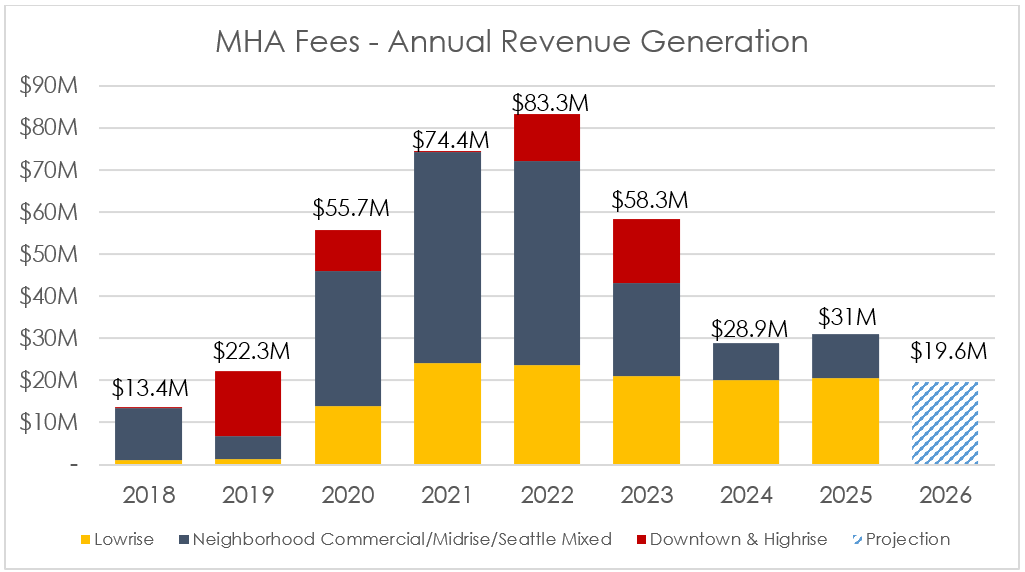
This is context for the negotiated proposal now under consideration: a two-year MHA Accelerator that reduces fees by 80% for multifamily projects and 90% for townhomes and projects under 30 units. It is a temporary recalibration meant to unlock thousands of homes while still generating significant revenue for affordable housing. Projects must begin construction within the two-year window to qualify, meaning only projects that actually build new homes, quickly, can benefit. And the relief is time-limited; the reduced rates expire at the end of the two-year term.
Some have argued reducing MHA fees would “stop the clock” on the city’s affordable housing commitments. The reality is that this portion of the clock is already stopped. More than 70 projects are currently in the permitting process, but are stalled out for lack of financing. The Seattle Housing Roundtable has brought forward information on 35 of them, accounting for roughly 6,700 homes, all unable to move because they cannot clear the return threshold their investors require. Those stalled projects produce nothing: no market-rate homes, no affordable homes, and no MHA revenue. The Accelerator is what can restart the clock. Even at the reduced rate, those 35 projects alone would generate roughly $24 million in MHA revenue in the first year, more than the frozen status quo is set to collect, while moving thousands of homes toward completion.
HDC did not agree to this negotiated reduction casually. But the data is clear: many market-rate multifamily developments do not pencil today, and a shallow reduction would be insufficient to move most of them past their return thresholds. To change an investment decision, the change in MHA fees has to be large enough to change the math. A more modest fee reduction, or tweak to payment timing alone, that still leaves projects stalled is not a sensible compromise. It sets us up for collective failure, as developers wait on the sidelines for rents to increase.
Protecting and growing the revenue that builds and maintains affordable housing across the continuum—from permanent supportive housing to affordable rental to affordable homeownership—is core to HDC’s mission. We would not support this proposal if we believed it sacrificed that revenue. That is why a central element of this MHA negotiation is a shared commitment among the City, HDC, and the Seattle Housing Roundtable to keep the Office of Housing’s affordable housing budget whole for the year, drawing on MHA fees collected at the Accelerator rate and other fund sources for affordable housing in the 2026 budget. Relief for stalled market rate housing production and a sustained affordable housing budget are the two halves of the same deal.
The MHA Accelerator is only a short-term bridge, and it needs to be paired with longer-term work. We are set to partner with the City on a new nexus study to set the program’s long-term structure on current economics, ensure it is legally durable, and reflect the world as it exists now.
We understand the instinct to defend MHA as it exists now, and we share the commitment to affordable housing behind it. But defending the existing fee levels while the pipeline empties does not protect affordable housing revenue or the program’s legitimacy. It risks both. Inclusionary zoning programs that fail to adapt to market conditions lose public support and, eventually, get dismantled.
The real choice is not between MHA as written and no MHA at all. It is between an MHA program that adapts to the city we live in today and one anchored to a market that no longer exists. As a member-based association of the affordable housing community, HDC chooses adaptation, because that is how we protect the program and the people who depend on affordable housing. We hope the Council will choose it too.